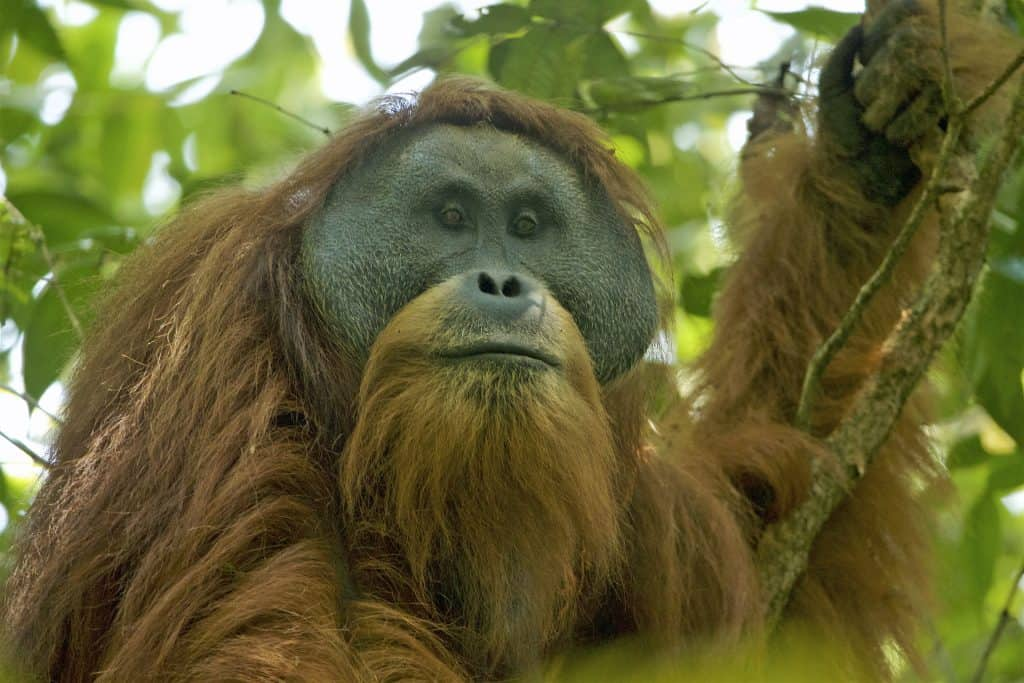
Newly published research in the journal Current Biology has revealed a silent tragedy in the rugged rainforests of North Sumatra, Indonesia (Meijaard et al., 2026). In late November 2025, a single extreme weather event—Cyclone Senyar—delivered a devastating blow to the critically endangered Tapanuli orangutan (Pongo tapanuliensis), wiping out an estimated 7% of the entire global population in just four days (Meijaard et al., 2026).
This catastrophic event represents an unprecedented demographic shock. For a species with fewer than 800 individuals left on Earth, this is not just a warning sign—it is an existential crisis that demands immediate, global action (Nater et al., 2017; Wich et al., 2019).
The Perfect Storm: Cyclone Senyar and the Geomorphological Collapse
Between November 23 and 28, 2025, Cyclone Senyar subjected the steep, volcanic slopes of North Sumatra to unprecedented rainfall (Meijaard et al., 2026). Meteorological data showed that a staggering 564 millimeters (22.2 inches) of rain fell in just five days directly over the West Block of the Batang Toru ecosystem—the primary stronghold of the Tapanuli orangutan (Meijaard et al., 2026).
This extreme deluge triggered high-velocity, shallow landslides and rapid debris flows (Meijaard et al., 2026). Striking without warning, these landslides swept down steep slopes and entered local drainage channels, transforming into highly destructive flows of mud, boulders, and uprooted trees (Meijaard et al., 2026). Post-cyclone satellite imagery mapped a deeply scarred landscape, revealing over 50,000 distinct landslide scars across the West Block (Meijaard et al., 2026).
This geomorphological disaster resulted in the immediate destruction of $8,303 \pm 1,760$ hectares of pristine forest—representing an 11.7% to 12% loss of the critical forest cover in the West Block (Meijaard et al., 2026).
An attribution analysis conducted by climate scientists revealed that human-induced global warming had supercharged this disaster, increasing Cyclone Senyar’s rainfall intensity by 9% to 50% (Meijaard et al., 2026). Worsened by a combination of a negative Indian Ocean Dipole and La Niña, this extreme storm also took a tragic human toll, claiming over 1,000 lives across Southeast Asia (Meijaard et al., 2026).
The Human Impact: Estimating the Population Loss
By overlaying pre-cyclone orangutan density maps with the locations of the 50,000 landslide scars, researchers calculated that approximately 58 individual Tapanuli orangutans were directly in the path of the landslides (Meijaard et al., 2026). Given the sudden, violent nature of these mudslides and the instant collapse of the canopy, arboreal escape was virtually impossible (Meijaard et al., 2026). These individuals likely perished from blunt-force trauma, suffocation, or drowning (Meijaard et al., 2026).
The loss of 58 individuals represents about 11% of the localized West Block population and 7% of the entire species’ global population (Meijaard et al., 2026). Conservation scientists emphasize that these figures are highly conservative, as they do not account for:
- Delayed deaths from severe physical injuries (Meijaard et al., 2026).
- Immediate mortality from rainfall-induced canopy breakage (Meijaard et al., 2026).
- Increased vulnerability to starvation and territorial stress (Meijaard et al., 2026).
The Anthropogenic Multiplier: How Industrial Infrastructure Primed the Slopes
While Cyclone Senyar was the physical trigger, decades of human encroachment and industrial development in the Batang Toru ecosystem severely worsened the disaster (Meijaard et al., 2021). Historically, Tapanuli orangutans did not choose rugged, high-elevation slopes as their primary habitat; they were gradually pushed there as agriculture, logging, and infrastructure cleared the more hospitable lowlands (Meijaard et al., 2021).
This forced migration placed the species in a geomorphologically volatile environment where slope stability is paramount (Meijaard et al., 2026). This stability has been systematically compromised by major industrial projects operating within the fragile ecosystem, including:
- The 510-megawatt Batang Toru hydroelectric power project (PT North Sumatra Hydro Energy) (Prasetyo et al., 2021).
- The Martabe gold mine (PT Agincourt Resources).
- Industrial pulpwood and timber concessions (PT Toba Pulp Lestari).
The construction of these projects required extensive forest clearing and the cutting of heavy infrastructure roads through steep terrain (Prasetyo et al., 2021). Post-disaster satellite imagery from December 2025 showed that landslides were highly concentrated directly along both sides of a newly constructed 20-kilometer access road built for the hydropower project on the west bank of the Batang Toru River. Furthermore, between 2021 and late 2025, pulpwood concession operations deforested at least 758 hectares of intact upland forest within the Aek Raja concession—land explicitly classified as protected and highly landslide-prone.
By stripping away the deep root networks of old-growth trees, which naturally bind the volcanic soil, these industrial operations primed the steep hillsides for catastrophic failure when the rains arrived.
The Ecological Ripple Effect: Soil Damage and Food Crises
For the surviving orangutans, the crisis is far from over. The landslides did not just fell trees; they stripped the rich, organic topsoil down to the bedrock. This topsoil contained the complex mycorrhizal fungal networks crucial for the nutrient absorption and growth of primary forest trees.
With the soil substrate gone, natural forest regeneration will be severely delayed. It is estimated that it will take five to ten years for basic pioneer forest vegetation to even begin establishing on the landslide scars, and decades more before mature, fruit-bearing canopy trees return.
Consequently, surviving orangutans are facing an immediate and severe energetic crisis. Vital forage trees, such as Castanopsis argantea, Artocarpus heterophyllus, and Aglaia tomentosa, which provide crucial phytochemicals and antioxidants for orangutan metabolic health, have been heavily depleted (Kuswanda et al., 2021). Surviving apes are being forced to travel longer distances over fragmented, steep terrain to find food, imposing a severe metabolic strain . This chronic nutritional stress can suppress ovulation in females, further depressing the species’ already slow reproductive rate.
This crisis also exposes the severe limitations of traditional wild-to-wild translocations (Sherman et al., 2024). Historical data shows that relocating wild orangutans from fragmented forest patches is highly stressful and demographically damaging, affecting an estimated 11.6% of Sumatran populations—a rate far exceeding sustainable mortality thresholds (Sherman et al., 2024). Translocated individuals suffer from low survival rates, struggle to adapt to unfamiliar territories, and often face aggressive territorial behavior from resident communities (Sherman et al., 2024).
Coexisting Species: The Sumatran Tiger and More
The biological importance of the Batang Toru ecosystem extends far beyond the Tapanuli orangutan (Wich et al., 2019). This 240,985-hectare forest represents a highly unique ecological mosaic, boasting up to 300 different plant species per hectare (Wich et al., 2019). Most notably, Batang Toru is the only primary forest ecosystem in Sumatra where three of the island’s most critically endangered large mammals—the Tapanuli orangutan, the Sumatran tiger (Panthera tigris sumatrae), and the Sumatran tapir (Tapirus indicus)—coexist sympatrically (Wich et al., 2019).
The steep slope failures have simultaneously fractured the hunting ranges and dispersal corridors of the Sumatran tiger (Wich et al., 2019). Recent intensive camera-trapping surveys have documented exceptionally high tiger densities in Batang Toru, ranging from 1.42 to 2.35 tigers per 100 square kilometers—nearly three to four times higher than densities recorded in the rugged mountains of Gunung Leuser National Park (Frontiers in Conservation Science, 2025). As landslides and roads fragment these habitats, tigers are increasingly forced out of the forest core and into human-dominated agricultural edges, driving a sharp increase in human-wildlife conflict and placing both local communities and tigers at extreme risk (Wich et al., 2019).
A Turning Point: Policy Action and the Path Forward
The unprecedented disaster of late 2025 has forced a dramatic and welcome reassessment of environmental licensing by the Indonesian government (Meijaard et al., 2026). Recognizing that the degradation of the Batang Toru watershed directly threatens both the survival of the world’s rarest great ape and the safety of human populations, the Ministry of Environment and Forestry took decisive action in early 2026 (Meijaard et al., 2026).
The government took the historic step of revoking the forestry and operating permits of key industrial developers, including PT North Sumatra Hydro Energy (NSHE) and PT Agincourt Resources (AR) (Meijaard et al., 2026). Additionally, civil lawsuits have been initiated against several companies across the mining, hydropower, pulpwood, and palm oil sectors, alleging direct links between their forest clearing operations and the deadly landslides (Meijaard et al., 2026).
To secure the long-term survival of the Tapanuli orangutan, we must advocate for a comprehensive, forward-looking conservation paradigm:
- Permanent Habitat Protection: The temporary halts on industrial activity must be converted into a permanent, legally binding ban on all extractive industries, infrastructure development, and large-scale logging within the entire Batang Toru ecosystem (Meijaard et al., 2026; Wich et al., 2019).
- Active Habitat Corridor Restoration: Immediate ecological restoration must be initiated along the heavily scarred landslide areas and abandoned industrial road cuts (Meijaard et al., 2026; Wich et al., 2019). Replanting native forage trees is essential to reconnect the isolated West, East, and South forest blocks (Meijaard et al., 2026; Wich et al., 2019).
- In-Situ Coexistence Programs: We must move away from wild-to-wild translocations, which are demographically damaging and unsustainable (Sherman et al., 2024). Instead, conservation funding should support in-situ protection, community-led agroforestry, and active forest patrols that allow humans and orangutans to safely share forest boundaries (Kuswanda et al., 2021; Sherman et al., 2024 ).
- Climate-Responsive Conservation Planning: Traditional conservation models assume static environments (Meijaard et al., 2026). Future species action plans must incorporate high-resolution climate modeling and geomorphological risk mapping to identify and proactively reinforce slope stability in areas of high orangutan density (Meijaard et al., 2026).
- Global Biodiversity-Recovery Financing: The burden of protecting this global heritage cannot fall on Indonesia alone (Meijaard et al., 2026). International partners must meet their global biodiversity commitments by providing immediate, sustained financial assistance to fund habitat restoration and support local sustainable livelihoods (Meijaard et al., 2026).
The tragedy of Cyclone Senyar has demonstrated that the crises of climate change and biodiversity loss are deeply and tragically interconnected (Meijaard et al., 2026). Protecting and restoring the forest home of the Tapanuli orangutan is no longer just an ecological goal; in a rapidly warming world, it is their only viable pathway to survival (Meijaard et al., 2026).
***
Artikel ini merupakan republikasi dari orangutan.com. Klik di sini untuk membaca dari sumber awal.